
Putnam U.S. Large Cap Growth Equity Concentrated
Mandate commentary
Q3 2026
Highlights
① The portfolio underperformed the benchmark during the period.
② Stock selection drove relative underperformance during the quarter.
③ Inflation, energy costs pushed long-term yields higher.
Mandate overview
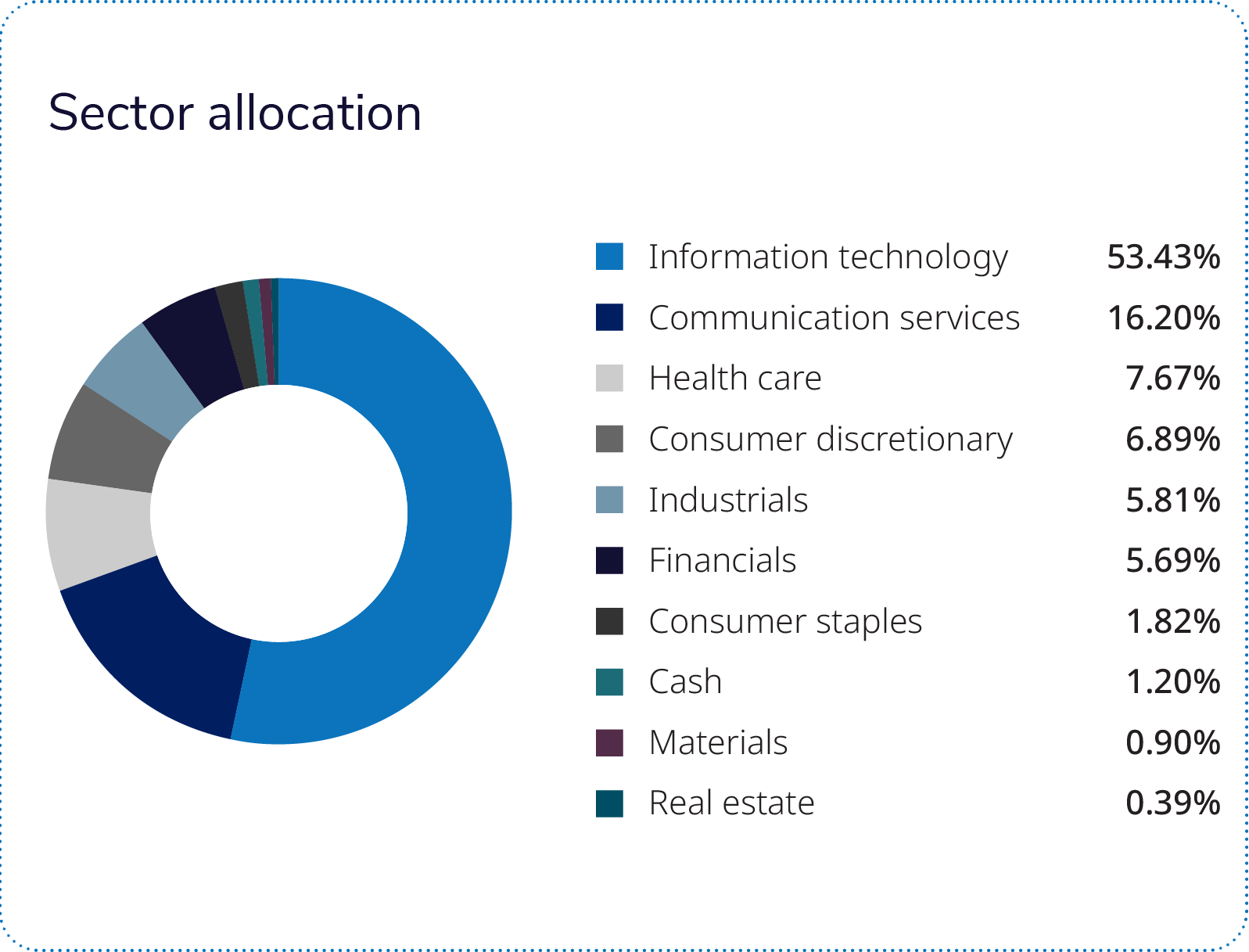 U.S. large-cap growth stocks posted a modest gain in the third quarter amid elevated valuations, higher interest rates and ongoing geopolitical uncertainty. The relatively muted quarterly return masked significant volatility beneath the surface, including a sharp reversal in market leadership during the first six weeks of the quarter. Technology remained an important driver of returns, with enthusiasm around artificial intelligence continuing, as the theme evolved from infrastructure investment toward more tangible evidence of monetization and productivity gains. Performance was mixed across industries and individual companies, as investors focused on the durability of earnings growth and returns on investment. Consumer resilience supported select discretionary businesses, while continued dispersion across the growth universe created opportunities for fundamental, stock-specific investing.
In this environment, the strategy underperformed its benchmark, the Russell 1000 Growth Index. It is worth noting that the vast majority of underperformance occurred during the sharp reversal in growth markets in July, with marginal underperformance in August and outperformance during September. For the quarter, names held in information technology and materials weighed most on relative results. Elsewhere in the portfolio, stock selection in consumer discretionary, financials and communication services proved relatively beneficial.
Mandate: U.S. Large Cap Growth Concentrated SMA
Performance contributors
Applied Materials – Lack of exposure to this underperforming name helped relative results. The portfolio favoured other semiconductor equipment companies.
KLA – Lack of exposure to this weak performing technology name offset some weakness elsewhere in the portfolio. The portfolio favoured other semiconductor equipment companies.
Snowflake – The portfolio’s overweight position proved beneficial, as the company reported stronger-than-expected revenue growth and increasing customer adoption of its artificial intelligence products boosted investor confidence in the company's long-term growth prospects.
Performance detractors
Lam Research – An overweight position weighed on results in the quarter. This company was a top contributor for the year-to-date period through June, but gave back strong performance in July. We continue to view this company as a long-term secular winner.
Corning – The portfolio’s overweight position had a negative impact. Investors grew concerned about slowing growth in its fiber-optic business, which supports artificial intelligence infrastructure, while weaker-than-expected sales expectations and softer demand for smartphone glass added pressure.
Coherent – A relative overweight weighed on results. While the company reported strong returns, it forecasted an increase in operating expenses. Investors grew concerned about the sustainability of spending on artificial intelligence infrastructure and the potential for new technologies to disrupt demand for the company’s products, despite continued strong business growth.
Total gross returns:
Total return (USD) | QTD | YTD | 1YR | 3YR | 5YR | SINCE INC. (FEB. 18, 2025) |
PUTNAM U.S. LARGE CAP GROWTH EQUITY CONCENTRATED | -0.01 | 6.30 |
Mandate positioning
There has been extensive discussion on index concentration and narrow leadership within the large-cap growth space. We are finally seeing some breadth in the growth universe across constituents and verticals, which is a notable and very welcome change. We are also starting to see a broader set of companies benefit from AI buildouts and monetization.
Recent earnings reports have provided greater evidence that incremental AI capacity is translating into accelerating cloud growth and measurable revenue and productivity gains. The conversation is beginning to shift toward the next phase of the buildout, including significant 2027 capital requirements, how those investments will be funded and potential constraints around power, memory and data-centre capacity. As AI-related capital expenditures absorb a greater share of hyperscaler operating cash flows, we believe the ability to efficiently fund this investment while generating attractive returns on that capital will become increasingly important.
Potential headwinds for equities include the possibility of a slowdown or extended pause in hyperscaler capital spending, which could weigh on the growth rates and valuations of a number of AI-related businesses. A material move higher in interest rates, elevated valuations and ongoing geopolitical tensions also remain important risks, particularly given their potential implications for inflation, financing costs and growth-stock multiples. We seek to mitigate these broader risks by constructing a portfolio in which the majority of risk is driven by stock-specific factors rather than any single macroeconomic or market variable. We would also note that strong equity returns are rarely realized in a straight line, and heightened volatility can bring ongoing risks as well as attractive opportunities for long-term, fundamental investors.
Changes in the relative positioning of the strategy are primarily a result of our fundamental, bottom-up process of evaluating the opportunity and risk of individual stocks. As always, sector active weights remain reasonably tight in order to reduce unintended factor risks and accentuate stock-specific risk. Currently, we remain within +/-5% of all sectors. Our largest absolute position is information technology; however, it is our largest underweight relative to the benchmark, followed by industrials. The portfolio is most overweight to health care and financials. We have no exposure to the energy and utilities sectors.
The strategy added two notable new positions (defined as 1% or larger) during the quarter, Palo Alto Networks (information technology) and Shopify (information technology). Exposure to Sherwin Williams (materials) was eliminated.
Market overview: earnings growth provided a powerful tailwind for equities
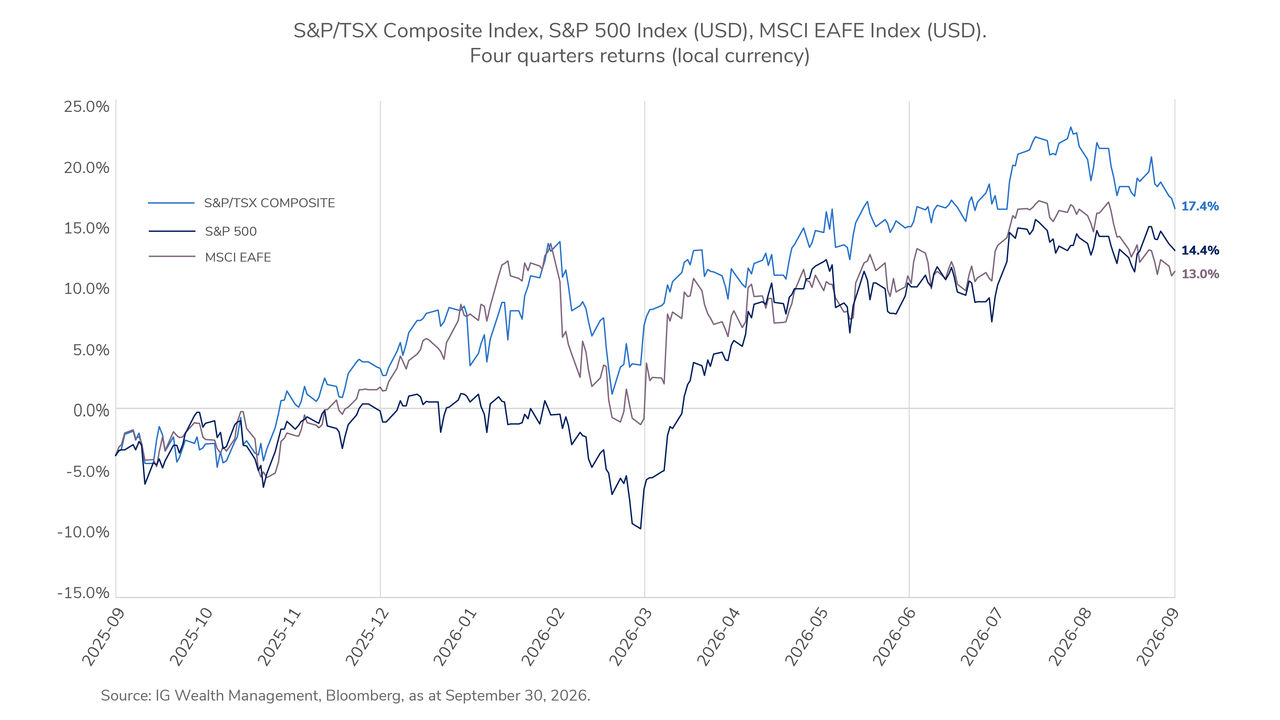
The third quarter showed that the current business cycle still has support, but risks have shifted. Growth held up, earnings improved and corporate investment remained firm, but higher oil prices, persistent inflation and rising long-term yields made the path forward less certain. Equities advanced as earnings provided fundamental support, even as higher rates raised the bar for further gains.
Canadian equities benefited from gains in resources and financials. Higher oil prices supported energy, while precious-metals companies were among the strongest performers. Bank earnings were supported by capital-markets activity, trading income and contained credit costs. U.S. equities also advanced, supported by strong earnings and continued technology investment. Higher yields weighed on more rate-sensitive areas.
International markets remained constructive overall, with parts of Asia benefiting from continued demand across the AI technology supply chain. Fixed income faced greater pressure as rising government bond yields outweighed coupon income, while credit remained comparatively resilient. Across markets, the central tension increasingly became earnings strength versus higher inflation and interest rates.
Market outlook: inflation, energy costs pushed long-term yields higher
With the recent earnings strength, the bar for market performance is higher. U.S. valuations are at the upper end of their historical range and have come under pressure from higher bond yields. Investor sentiment points to strong earnings growth going-forward, which could support equities in the near term, but the magnitude of gains may be muted.
The U.S. Federal Reserve and Bank of Canada each face two rate decisions this year, and persistent inflation has shifted central banks toward a tighter policy stance. Long-term yields remain a pressure point for equities, while also improving the income available from bonds.
The U.S. midterms may add to market volatility, but the path forward will be shaped by the economic cycle, inflation and interest rates.
To discuss your investment strategy, speak to your IG Advisor.
Azure Managed Investments™ provides discretionary investment management services distributed by IG Wealth Management Inc., Investment dealer. We will manage your Azure Managed Investments Accounts on a segregated basis in accordance with your investment policy statement and the resulting mandate selected by you. Mandates will be managed by I.G. Investment Management, Ltd. and partner organizations. You are required to make a minimum initial investment of $150,000; please read the Azure Managed Investment Account Agreement for complete details, including fees and expenses.
This commentary may contain forward-looking information, which reflects our or third-party current expectations or forecasts of future events. Forward-looking information is inherently subject to, among other things, risks, uncertainties and assumptions that could cause actual results to differ materially from those expressed herein. These risks, uncertainties and assumptions include, without limitation, general economic, political and market factors, interest and foreign exchange rates, the volatility of equity and capital markets, business competition, technological change, changes in government regulations, changes in tax laws, unexpected judicial or regulatory proceedings and catastrophic events. Please consider these and other factors carefully and do not place undue reliance on forward-looking information. The forward-looking information contained herein is current only as of September 30, 2026. There should be no expectation that such information will in all circumstances be updated, supplemented or revised, whether as a result of new information, changing circumstances, future events or otherwise.
This commentary is published by IG Wealth Management. It is provided as a general source of information. It is not intended to provide investment advice or as an endorsement of any investment. Some of the securities mentioned may be owned by IG Wealth Management or its mutual funds, or by portfolios managed by our external advisors. It may contain certain forward-looking statements regarding the market conditions which are based upon assumptions believed to be reasonable at the time of publishing. Every effort has been made to ensure that the material contained in the commentary is accurate at the time of publication, however, IG Wealth Management cannot guarantee the accuracy or the completeness of such material and accepts no responsibility for any loss arising from any use of or reliance on the information contained herein.
Past performance may not be repeated and is not indicative of future results. Actual performance may vary due to a range of factors including but not limited to current market conditions, timing of contributions and withdrawals, client-imposed restrictions, fees, expenses, tax considerations and other individual circumstances. There are no assurances that any mandate will achieve its objectives and/or avoid any losses.
Trademarks, including IG Wealth Management and IG Private Wealth Management, are owned by IGM Financial Inc. and licensed to subsidiary corporations.
©2026 IGWM Inc.