
Mackenzie Short Duration Fixed Income
Mandate commentary
Q3 2026
Highlights
① The portfolio outperformed its benchmark, supported by its federal bond underweight and shorter duration despite provincial, corporate and futures headwinds.
② Earnings growth provided a powerful tailwind for equities.
③ Inflation, energy costs pushed long-term yields higher.
Mandate overview
 The third quarter was difficult for duration. The 10-year United States Treasury yield rose from 4.44% to 5.29%, as elevated energy prices, the September U.S. Federal Reserve rate increase and persistent inflation shifted markets away from an easing narrative. Resilient economic activity in the United States, continued artificial-intelligence-related capital spending and heavy corporate issuance added pressure to the long end, while August unemployment held at 4.1% and core personal consumption expenditures inflation remained 3% year over year.
Canada also proved more resilient than expected. Data released during the quarter showed second-quarter growth of 3.3% annualized, supported by consumption, exports and investment, while population revisions reduced some near-term housing concerns. Affordability, household leverage and mortgage refinancing remain constraints, however, and the team expects any Bank of Canada tightening cycle to be shallow.
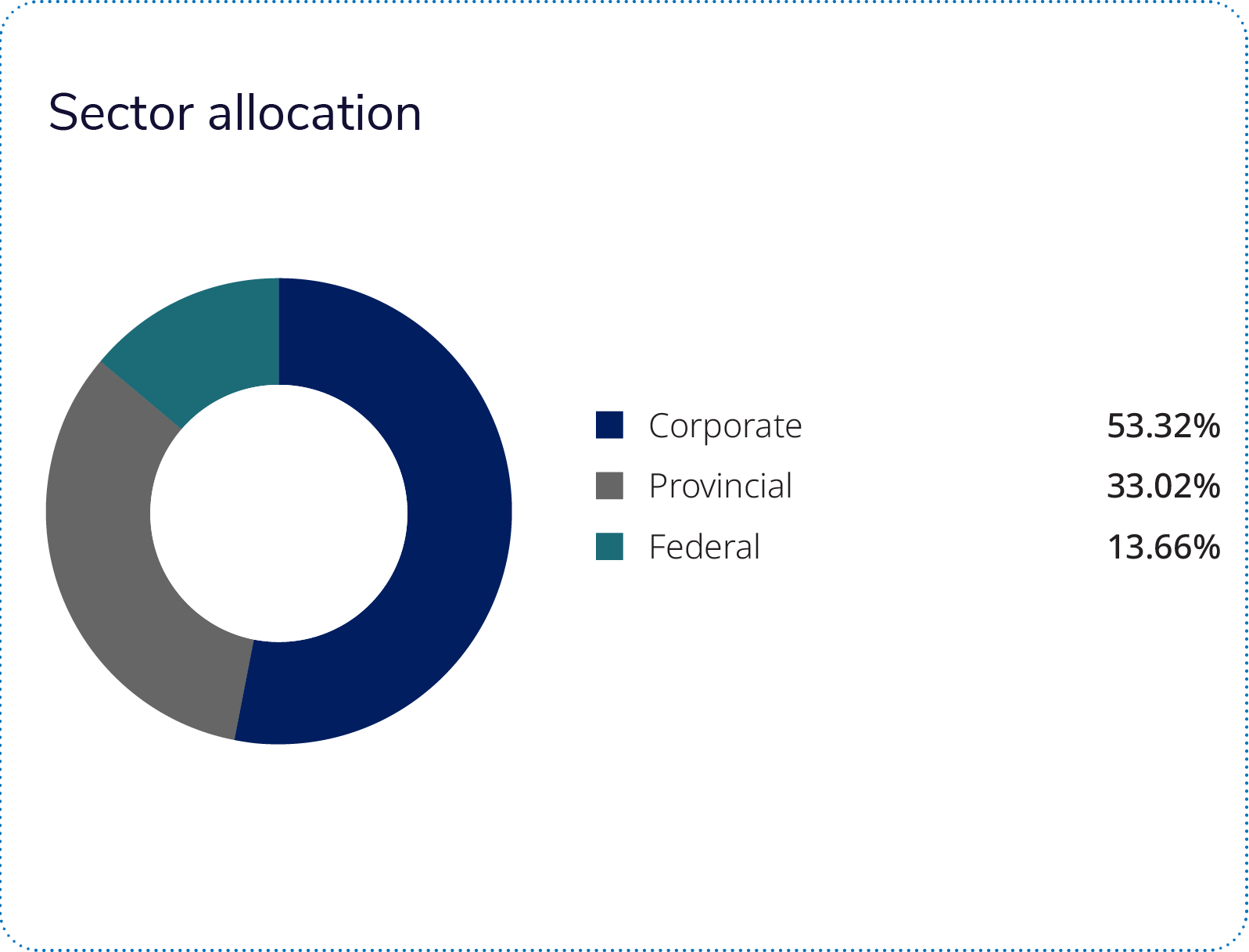
The portfolio maintained a pronounced corporate-credit overweight and government underweight. Corporate exposure averaged 67% and ended the quarter at 65%, compared with 31.6% and 31.4%, respectively, for the benchmark. Government exposure averaged 31.2% and ended at 34.3%, versus 68.4% and 68.6% for the benchmark. Average effective duration was 2.78 years, modestly below the benchmark at 2.82 years.
The quarter-end mix reflected a lower corporate allocation and a higher government allocation than at the beginning of the period. Within governments, the portfolio remained overweight provincial bonds and substantially underweight federal bonds, leaving performance more exposed to provincial spreads but less sensitive to the federal-market sell-off.
Despite a negative absolute quarter for Canadian Short-Term Fixed Income, the portfolio outperformed its benchmark. Government bond positioning was the dominant source of relative value, led by the underweight to federal bonds, as yields rose. This benefit was partially offset by negative results from provincial bonds, corporate credit, five-year Canada bond futures and currency forwards. Allocation and security-selection effects were positive overall, while currency effects detracted modestly.
Mandate: Mackenzie Short Duration Fixed Income overview
Performance contributors
The federal underweight was the largest contributor. Federal bonds represented roughly 10.2% of the portfolio on average versus 51.4% of the benchmark, and the portfolio's slightly shorter average duration helped limit losses as the yield curve repriced higher.
Selected short-maturity financial, real estate and energy holdings generated positive income and relative performance. Bank-loan and derivative exposures also added modestly.
Performance detractors
Provincial bonds were the largest offset, reflecting an overweight position and weaker results from Quebec, Alberta and Ontario issues. The portfolio's provincial sleeve also carried more duration than the benchmark, increasing its sensitivity to the rise in yields.
Corporate positioning detracted overall, led by financials, industrials and infrastructure. Canadian five-year bond futures and currency-forward hedges further detracted from relative performance.
Total gross returns:
Total return (CAD) | QTD | YTD | 1YR | 3YR | 5YR | SINCE INC. (FEB. 18, 2025) |
MACKENZIE SHORT DURATION FIXED INCOME | -0.71
| 0.20
|
Mandate positioning
Corporate exposure declined from 70.1% to 65% during the quarter, while government exposure increased from 29.4% to 34.3%. Even after this shift, the portfolio remained materially overweight corporate credit and underweight government bonds, with average duration kept modestly shorter than the benchmark.
Looking ahead, the team remains cautious about adding outright duration. Persistent energy-driven inflation, government debt and deficit concerns and continued artificial-intelligence-related issuance are likely to keep yields volatile. At the same time, higher all-in yields have improved the income available in corporate bonds, supporting a selective focus on credit carry and relative-value opportunities rather than a broad extension of duration.
Market overview: earnings growth provided a powerful tailwind for equities
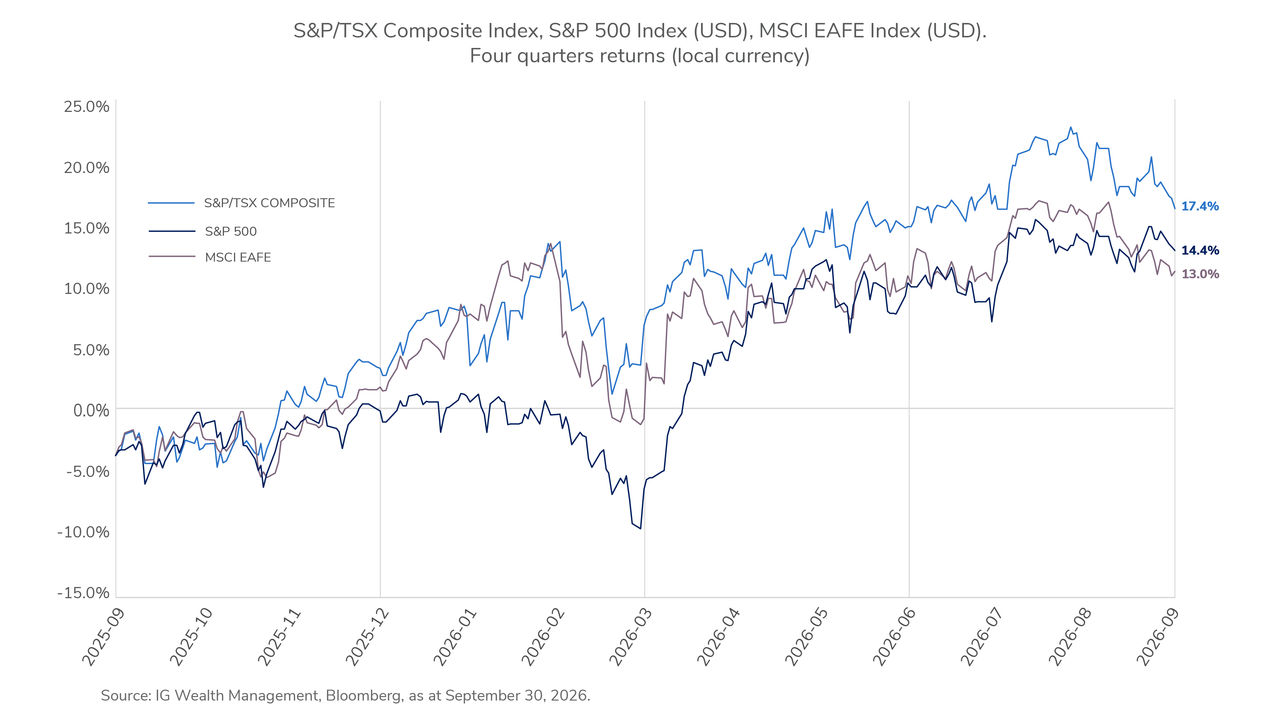
The third quarter showed that the current business cycle still has support, but risks have shifted. Growth held up, earnings improved and corporate investment remained firm, but higher oil prices, persistent inflation and rising long-term yields made the path forward less certain. Equities advanced as earnings provided fundamental support, even as higher rates raised the bar for further gains.
Canadian equities benefited from gains in resources and financials. Higher oil prices supported energy, while precious-metals companies were among the strongest performers. Bank earnings were supported by capital-markets activity, trading income and contained credit costs. U.S. equities also advanced, supported by strong earnings and continued technology investment. Higher yields weighed on more rate-sensitive areas.
International markets remained constructive overall, with parts of Asia benefiting from continued demand across the AI technology supply chain. Fixed income faced greater pressure as rising government bond yields outweighed coupon income, while credit remained comparatively resilient. Across markets, the central tension increasingly became earnings strength versus higher inflation and interest rates.
Market outlook: inflation, energy costs pushed long-term yields higher
With the recent earnings strength, the bar for market performance is higher. U.S. valuations are at the upper end of their historical range and have come under pressure from higher bond yields. Investor sentiment points to strong earnings growth going-forward, which could support equities in the near term, but the magnitude of gains may be muted.
The U.S. Federal Reserve and Bank of Canada each face two rate decisions this year, and persistent inflation has shifted central banks toward a tighter policy stance. Long-term yields remain a pressure point for equities, while also improving the income available from bonds.
The U.S. midterms may add to market volatility, but the path forward will be shaped by the economic cycle, inflation and interest rates.
To discuss your investment strategy, speak to your IG Advisor.
Azure Managed Investments™ provides discretionary investment management services distributed by IG Wealth Management Inc., Investment dealer. We will manage your Azure Managed Investments Accounts on a segregated basis in accordance with your investment policy statement and the resulting mandate selected by you. Mandates will be managed by I.G. Investment Management, Ltd. and partner organizations. You are required to make a minimum initial investment of $150,000; please read the Azure Managed Investment Account Agreement for complete details, including fees and expenses.
This commentary may contain forward-looking information, which reflects our or third-party current expectations or forecasts of future events. Forward-looking information is inherently subject to, among other things, risks, uncertainties and assumptions that could cause actual results to differ materially from those expressed herein. These risks, uncertainties and assumptions include, without limitation, general economic, political and market factors, interest and foreign exchange rates, the volatility of equity and capital markets, business competition, technological change, changes in government regulations, changes in tax laws, unexpected judicial or regulatory proceedings and catastrophic events. Please consider these and other factors carefully and do not place undue reliance on forward-looking information. The forward-looking information contained herein is current only as of September 30, 2026. There should be no expectation that such information will in all circumstances be updated, supplemented or revised, whether as a result of new information, changing circumstances, future events or otherwise.
This commentary is published by IG Wealth Management. It is provided as a general source of information. It is not intended to provide investment advice or as an endorsement of any investment. Some of the securities mentioned may be owned by IG Wealth Management or its mutual funds, or by portfolios managed by our external advisors. It may contain certain forward-looking statements regarding the market conditions which are based upon assumptions believed to be reasonable at the time of publishing. Every effort has been made to ensure that the material contained in the commentary is accurate at the time of publication, however, IG Wealth Management cannot guarantee the accuracy or the completeness of such material and accepts no responsibility for any loss arising from any use of or reliance on the information contained herein.
Past performance may not be repeated and is not indicative of future results. Actual performance may vary due to a range of factors including but not limited to current market conditions, timing of contributions and withdrawals, client-imposed restrictions, fees, expenses, tax considerations and other individual circumstances. There are no assurances that any mandate will achieve its objectives and/or avoid any losses.
Trademarks, including IG Wealth Management and IG Private Wealth Management, are owned by IGM Financial Inc. and licensed to subsidiary corporations.
©2026 IGWM Inc.